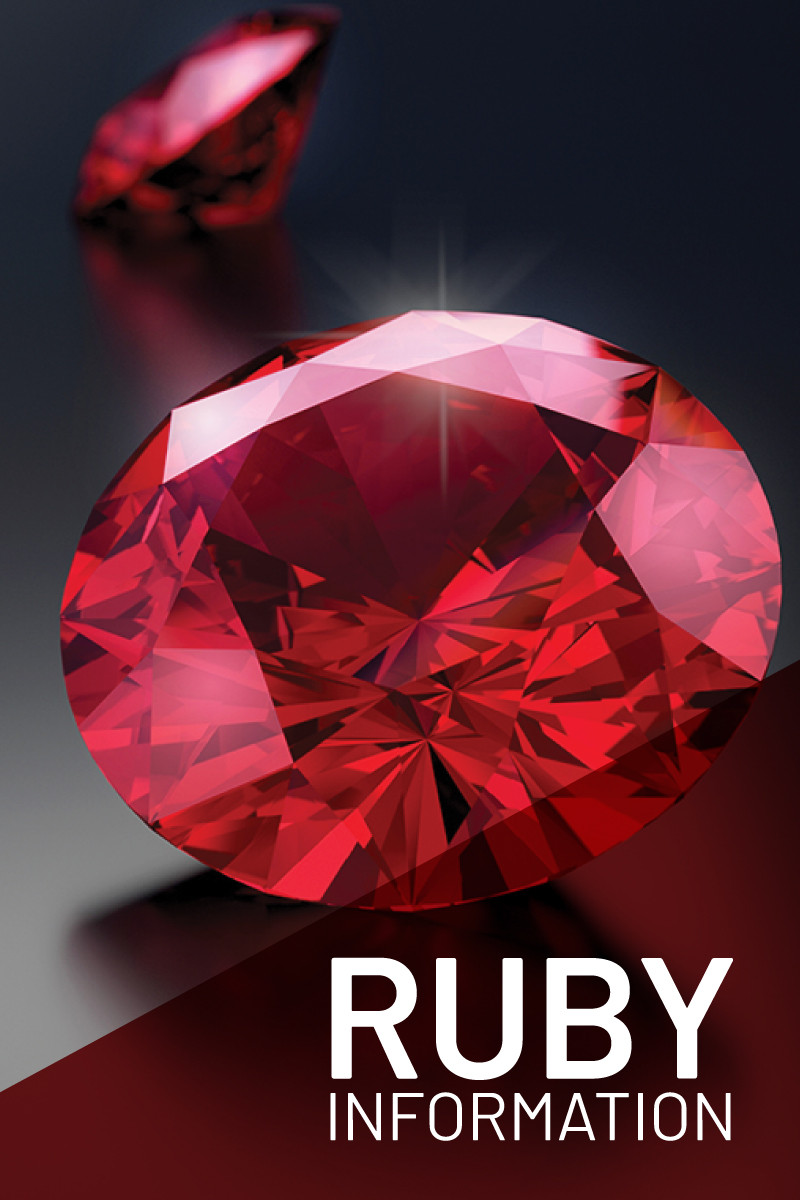
There's a moment in every gemologist's life when they truly see a ruby for the first time. Not a commercial, slightly purplish thing in a chain-store ring, but a proper, earth-born crystal with that impossible inner glow. For me, it happened in my trading office 10 years ago. The old dealer slid a one-carat stone across a wooden table, just morning light streaming through a grimy window. I remember my breath catching. The ruby wasn't just red; it was a living, breathing crimson, pulsing with a secret fire I'd only read about in textbooks. That's the effect a fine ruby has on you.
So let's talk about what makes this gem truly extraordinary.
The Science of Ruby
Let's start with the science, because understanding ruby's physical character explains everything about its rarity and radiance. Ruby is a variety of the mineral corundum, a crystalline form of aluminium oxide (Al₂O₃). In its pure state, corundum is colourless. Ruby gets its legendary redness from chromium atoms that elbow their way into the crystal lattice. Trace amounts of chromium, sometimes as little as 0.1%, replace aluminium, and that tiny invasion is responsible for the colour, the fluorescence, and the name. If chromium content pushes the colour into pink territory, the trade has an ongoing debate about where pink sapphire ends and ruby begins. I keep it simple: if the dominant hue is red, even pinkish-red, it's a ruby in my book. And that chromium? It's also why ruby absorbs yellow-green light and re-emits it as red, a phenomenon called fluorescence, which makes top rubies glow.
Before I dive deeper, here are the statistics that every collector, gemmologist, or jewellery lover should know.
| Property | Value / Description |
|---|---|
| Chemical Composition | Aluminium oxide with chromium (Al₂O₃:Cr) |
| Crystal System | Trigonal |
| Hardness (Mohs) | 9 (extremely durable; only diamond and moissanite are harder) |
| Refractive Index (RI) | 1.762 – 1.770 (exceptionally bright lustre) |
| Birefringence | 0.008 – 0.010 (visible doubling of back facets under a loupe) |
| Specific Gravity (SG) | 3.97 – 4.05 (feels noticeably heavy in the hand) |
| Pleochroism | Strong; orangy-red vs. purplish-red (you can see two shades depending on direction) |
| Fluorescence | Strong red under long-wave UV (the chromium glow); weaker under short-wave |
| Cleavage | None, but twinning planes can create parting |
| Lustre | Vitreous to sub-adamantine |
| Dispersion (Fire) | 0.018 (low, but masked by body colour and fluorescence) |
| Common Inclusions | Rutile silk, apatite crystals, boehmite needles, fingerprint inclusions |
A specific gravity close to 4.0 means a ruby will feel heavier than a garnet of the same size, a quick separation trick I use in the field. The hardness of 9 makes ruby ideal for daily-wear rings, but also means only diamond powder can polish it. The birefringence lets a sharp-eyed gemmologist spot overlapping facet edges — a telltale sign of corundum.
Where the Fire Comes From: Origins
Now, where does all that fire come from? Origin plays a huge role. The classic source, the one that haunts my dreams, is the Mogok Valley in Myanmar (Burma). Mogok rubies often display that legendary "pigeon's blood" red — a pure, vivid crimson with a subtle bluish overtone that tempers any orange or brown. The presence of extremely fine rutile silk inclusions scatters light, giving stones a soft, velvety glow.
In recent decades, Mozambique has emerged as a powerhouse. Mozambican rubies can rival Burma's finest, often with a more open, slightly fluorescent red and startling clarity. I've seen ten-carat rough from Montepuez cut into gems that make my knees weak. They tend to have less pervasive silk and more crystal or fingerprint inclusions, but the colour saturation is intense. Other important sources include Thailand and Cambodia, which usually produce darker, garnet-like rubies (often with high iron content that kills fluorescence), and Madagascar, Sri Lanka, and Tanzania. Each location stamps its own fingerprint on the stone, and origin can swing the price by a factor of two or three, as any auction catalogue will show you.
Clarity: A Ruby's Diary
Clarity in ruby is a conversation I have almost daily. A flawless ruby? Genuinely, I've seen perhaps three in ten years, and all were under half a carat. Inclusions aren't just acceptable; they're expected. They prove natural origin. The silk I mentioned can, when dense and oriented correctly, produce asterism — a floating six-rayed star. I'll never forget a cabochon star ruby I held during a power cut in Sri Lanka, the star so sharp and centred that it looked like a celestial sign. That stone's inclusions were its entire beauty. Of course, an inclusion that threatens durability or sits smack in the middle of the table is a flaw, but tiny silk, fine needles, or healed fractures deep in the pavilion? Those are a ruby's diary, written in geological ink.
Treatments: Transparency Matters
This brings me to treatments, a topic I insist on transparency about. Heating is standard and ancient. By gently heating ruby to around 1700°C, we can dissolve fine rutile silk, improving clarity and sometimes intensifying colour. In my mind, a heated ruby is still a totally natural gem; we're simply finishing what the earth started. Unheated, fine rubies, however, command massive premiums. I once brokered a 2.5-carat unheated Burmese ruby that traded for the price of a luxury car, while a visually identical heated stone from the same parcel sold for a fraction. The key is disclosure.
⚠️ Warning: Avoid Fracture-Filled Rubies
- High-lead glass filling makes fractured rubies look gemmy but fragile
- Can shatter during simple re-tipping or cleaning
- Damaged by household cleaners and even sunlight heat
- If a ruby looks too big and clean for a few hundred dollars — run away
The Lore of Ruby
The lore of ruby runs as deep as the mines. In Sanskrit, ruby was ratnaraj, the king of precious stones. The ancient Chinese inlaid armour with rubies, and Hindus believed offering rubies to Krishna would ensure rebirth as an emperor. Burmese warriors embedded rubies under their skin, believing they made them invincible. It's a talisman of passion, protection, and prosperity. Ruby is still the gift for 15th and 40th wedding anniversaries, for July birthdays, and for anyone who wants to be noticed.
Buying Advice from a Gemologist
If you're buying a ruby, my advice is this: colour above all else. Look at the stone in morning sun, under incandescent light, and in shade — it should glow red in all of them. Prioritise a vibrant, slightly pinkish or bluish-red over a dark, lifeless stone. Accept a smaller size for exceptional colour. Demand a report from a reputable gem lab (GIA, GRS, Lotus, SSEF) that states geographic origin and any treatments. And find a jeweller who's as passionate about the stone as you are, someone who will talk about the silk, the fluorescence, and the stone's story.
"Ruby is not a shy gem. It demands presence, and it gives back a lifetime of fire. Millions of years of heat and pressure, crystallised into a tiny red kingdom. Wear it with respect, and it will never stop glowing."