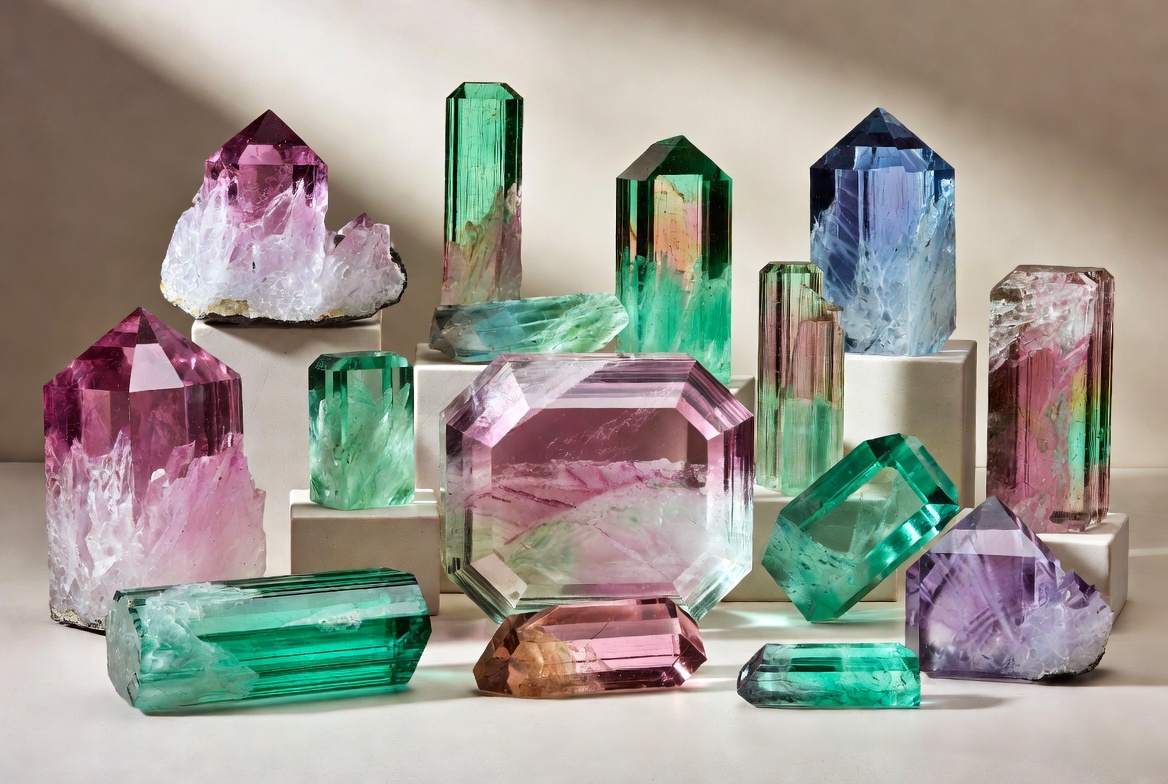
What is Tourmaline?
Tourmaline belongs to a complex group of boron silicate minerals with a similar crystal structure but varying chemical compositions — and that variation is exactly what gives tourmaline its incredible range of colors. Often called the "rainbow gem," it comes in virtually every color of the spectrum, and sometimes multiple colors in a single crystal.
The most important gem-quality species is elbaite, though other types like dravite and liddicoatite also produce beautiful stones. The name "tourmaline" itself comes from the Sinhalese word toramalli, meaning "mixed gems" — reflecting how early traders in Sri Lanka grouped these colorful pebbles with other stones.
Gemological Properties
Tourmaline is a reliable choice for everyday jewelry thanks to its solid physical properties:
| Mohs Hardness | 7.0 – 7.5 (suitable for rings, pendants & earrings) |
| Specific Gravity | Typically 3.06 (range: 2.8 – 3.3) |
| Refractive Index | 1.624 – 1.644 |
| Birefringence | 0.018 – 0.040 (uniaxial negative) |
| Crystal System | Trigonal — rounded triangular cross-section |
| Cleavage | Indistinct; fracture uneven to conchoidal |
| Luster | Vitreous (glass-like) |
| Transparency | Transparent to opaque |
| Pleochroism | Strong — color shifts when viewed at different angles |
Colors & Popular Varieties
Tourmaline's color range is unmatched in the gem world. Here are the most sought-after varieties:
Rubellite
Pink to vivid red, colored by manganese. High-quality rubellite rivals fine ruby in beauty and is in strong demand worldwide.
Paraíba Tourmaline
The rarest and most expensive variety. Copper-bearing elbaite from Brazil and Africa produces electric neon blues and greens that seem to glow from within.
Verdelite (Green)
Ranges from mint to deep forest green, caused by iron or chromium. Chrome tourmaline can closely resemble fine emerald.
Watermelon
Iconic bicolor with a pink core and green outer layer — nature's own slice of watermelon. Highly popular for natural color zoning.
Dravite (Brown)
Warm honey to dark brown tones. Less known but prized by collectors for its earthy, natural appeal and strong clarity.
Schorl (Black)
The most common form of tourmaline. Popular in metaphysical circles for its reputed protective energies.
Origins & Sources
Tourmaline is mined across the globe, with each origin often producing stones of distinct character and color:
Brazil remains the world's most celebrated source, particularly for the legendary Paraíba tourmalines discovered in the 1980s. Mozambique and Nigeria have since emerged as important African sources producing comparable neon copper-bearing stones.
How to Care for Tourmaline
Tourmaline is relatively low-maintenance, but benefits from gentle and consistent care:
- Clean with warm soapy water and a soft brush only. Avoid ultrasonic and steam cleaners, which can cause fractures in included or treated stones.
- Protect from sudden temperature changes and prolonged high heat, which may affect color in treated material.
- Store separately from harder gems like diamonds or sapphires to prevent surface scratches.
- Remove tourmaline rings during heavy manual work — the gem has fair toughness but can chip under sharp impact.
- With proper care, a beautiful tourmaline piece can last and delight for generations.
Buying Guide: What to Look For
When shopping for tourmaline, keep these key value factors in mind:
Color
The most important factor. Vivid, evenly distributed color with strong saturation commands the highest prices. Paraíba neon blues and vivid rubellite reds are at the top.
Clarity
Eye-clean stones are preferred. Some inclusions are accepted in lower-priced material, but Paraíba stones should be as clean as possible due to their high value.
Cut
Well-proportioned cuts maximize brilliance and best showcase the stone's pleochroism — look for even facets and good light return.
Origin & Treatment
Paraíba and top rubellites carry origin premiums. Always ask about treatments — heat and irradiation are common in the trade and should be fully disclosed.
Tourmaline offers exceptional value compared to rarer gems while providing unmatched variety and character — a perfect choice for collectors and jewelry lovers alike.