I still remember the first time I held a fine Kashmir sapphire under the loupe. It was in a dusty old shop in Bangkok many years ago, and as I tilted it in the light, that velvety cornflower blue seemed to glow from within, almost alive. I've been chasing that feeling ever since.
As a gemstone dealer with over 11 years in the trade, traveling from the mines of Sri Lanka to the remote Himalayan mountains, I've come to believe that sapphire isn't just a gemstone — it's a piece of the Earth's quiet poetry.
The Science of Sapphire
Sapphire belongs to the corundum family, the same mineral that gives us ruby. Chemically, it's aluminum oxide (Al₂O₃), one of the hardest natural substances on the planet with a Mohs hardness of 9. Only diamond ranks higher. This durability makes sapphire an ideal choice for everyday jewelry, especially engagement rings that need to survive a lifetime of wear.
Sapphire Technical Specifications
- Chemical Formula: Al₂O₃ (Aluminum Oxide)
- Mohs Hardness: 9 (Second only to diamond)
- Refractive Index: 1.76 – 1.77
- Specific Gravity: ~4.00
- Crystal System: Trigonal
Its refractive index sits around 1.76-1.77, giving it that crisp brilliance, and its specific gravity hovers near 4.00. But numbers only tell part of the story. What truly captivates us is the color.
A Rainbow of Colors
While most people associate sapphire with that classic deep blue, the truth is far more colorful. Trace elements create an astonishing palette: iron and titanium for blue, chromium for pink, vanadium for color-change varieties that shift from blue to purple depending on the light, and even orange, yellow, green, and purple "fancy" sapphires.
Padparadscha sapphires from Sri Lanka, with their delicate lotus-blossom pink-orange hue, are among the most coveted and expensive. Then there are the phenomenal stars — sapphires showing asterism, where rutile needles align to create a six-rayed star that dances across the dome of a cabochon cut.
The Legendary Origins
Kashmir — The Gold Standard
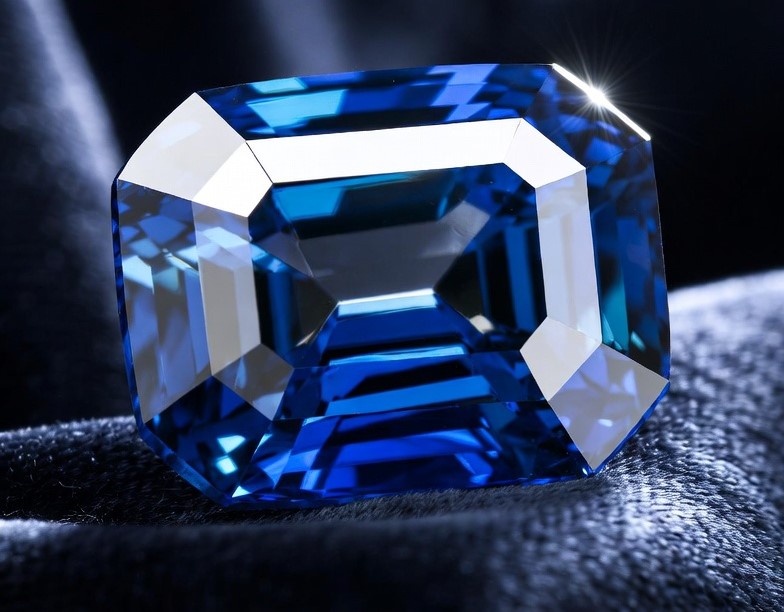
My favorite remains the royal blue sapphire. The very best examples display what we call "velvety" texture — a soft, saturated color without gray or greenish undertones, with excellent transparency. Kashmir sapphires set the gold standard here.
That pure cornflower blue, consistent in all lighting conditions, commands prices that can reach tens or even hundreds of thousands of dollars per carat for top specimens.
— Market Analysis, 2025Discovered in the late 19th century in the remote Zanskar region of the Himalayas, these stones are legendary. Production was limited and the mines have been largely exhausted for decades, making them the rarest sapphire. The Regent Kashmir Sapphire (May 2025, Christie's Hong Kong): 35.09 carats sold for $9.5 million.
Myanmar, Sri Lanka & Beyond
Close behind are sapphires from Myanmar (Burma) and Sri Lanka (formerly Ceylon). Burmese stones often show a slightly more intense, sometimes royal blue with a hint of violet. Sri Lankan sapphires tend to be lighter, brighter, and more lively — perfect for those who prefer a vivid, crystalline appearance.
| Origin | Color Characteristic | Notable Features |
|---|---|---|
| Kashmir | Velvety cornflower blue | Rarest, mines exhausted, highest prices |
| Myanmar (Burma) | Intense royal blue with violet hint | Rich saturation, highly prized |
| Sri Lanka (Ceylon) | Lighter, brighter, lively blue | Excellent transparency, vivid appearance |
| Madagascar | Beautiful blues rivaling older origins | Major modern source, excellent when color is right |
| Australia | Darker, inky blues; parti-colored stones | Unique metallic-looking varieties |
| Montana, USA | Small, metallic-looking with distinctive sparkle | American origin, unique character |
Madagascar has emerged as a major modern source, producing beautiful blues that can rival older origins when the color is right. Australia gives us darker, inky blues and some delightful parti-colored stones, while Montana in the USA produces small but uniquely metallic-looking sapphires with a distinctive sparkle.
History & Symbolism
The history of sapphire stretches back thousands of years. Ancient Persians believed the sky was a giant sapphire reflecting its color onto the Earth. Kings and queens have worn them for protection and insight — Prince Charles famously gave Princess Diana a sapphire engagement ring, a piece now iconic.
In the Middle Ages, clergy wore sapphires as symbols of heaven, and medieval physicians ground them into potions (not recommended today!). Even today, many cultures view sapphire as a stone of loyalty, focus, and inner peace. It's the September birthstone, and in astrology, it's linked to calming Jupiter's influence.
Geological Formation
Geologically, sapphires form under incredible conditions — high heat and pressure in metamorphic or igneous rocks, often associated with marble or basalt. They weather out into alluvial deposits, which is why so many are mined from river gravels rather than hard rock.
Miners in Sri Lanka still use traditional methods, washing gravel by hand in rivers, a process little changed for centuries. In my travels, I've seen how sapphires connect people across cultures and time. From a young miner in Ratnapura proudly showing me a rough crystal still wet from the river, to a collector in Bangkok carefully unwrapping a velvet box containing a historic Kashmir, these gems carry stories.
Gemological Identification
In the lab, we gemologists have many tools to understand these stones. The spectroscope reveals absorption lines from trace elements, the polariscope shows the doubly refractive nature of corundum, and inclusion patterns tell us origin. Kashmir stones often show fine "silk" and a characteristic swirl-like structure, while Sri Lankan ones might contain zircon crystals with halos.
Origin Identification "Fingerprints"
- Kashmir: Fine "silk" inclusions, characteristic swirl-like structure
- Sri Lanka: Zircon crystals with halos, rutile needles
- Myanmar: Short rutile needles, dense silk
- Madagascar: Similar to Sri Lankan, requires advanced testing
These "fingerprints" help separate natural from synthetic and verify origin — crucial in today's market.
Treatments & Market Reality
Treatments are an important reality in the sapphire world. Most commercial sapphires undergo heat treatment to improve color and clarity by dissolving inclusions or enhancing hue. This is stable and widely accepted when disclosed.
Always Ask for a Lab Report
More advanced treatments like lattice diffusion or fracture filling exist too, and buyers should always ask for full disclosure and a reputable lab report. GIA, Gübelin, and SSEF are the gold standards. Untreated stones of fine color carry a significant premium, especially in larger sizes.
Caring for Your Sapphire
Caring for your sapphire is straightforward thanks to its toughness. Warm soapy water and a soft brush work great. Ultrasonic cleaners are generally safe for heat-treated stones, but I always recommend caution with heavily fractured or filled pieces. Avoid sudden temperature changes and harsh chemicals. A good sapphire, well-set, will outlast generations with minimal care.
Sapphire Care Guide
- Clean with warm soapy water and soft brush
- Ultrasonic cleaners generally safe for heat-treated stones
- Avoid with heavily fractured or filled pieces
- Keep away from sudden temperature changes
- Avoid harsh chemicals and abrasives
A Timeless Treasure
Whether you choose a classic blue sapphire, a rainbow collection of fancy sapphires, or a star sapphire stone, a sapphire rewards the owner with quiet joy every time it's worn. After all these years, I still get that same thrill I felt in that Bangkok shop.
There's something almost spiritual about a fine sapphire and leaves you wondering at the forces that created such perfection. In a world of fast fashion, sapphire remains timeless — a true gem of its kind.
— AA Gems & Jewelry Read about rubies →